
11 June 2026
DGCA Exam Syllabus 2026 — Complete Guide for CPL & ATPL Aspirants
Planning to crack your DGCA exams in 2026? This complete guide breaks down the full DGCA exam syllabus; subject-wise topics, exam pattern, 2026 updates, & study roadmap.
Why the DGCA Exam Is the Gateway to Your Pilot Career
Every commercial pilot career in India begins the same way: by clearing the DGCA theory examinations. Whether you are aiming for a Commercial Pilot Licence or eventually an Airline Transport Pilot Licence, these papers are essential. They test the knowledge you will use every day in the cockpit, including navigation, meteorology, regulations, and aircraft systems.
In 2026, the standards are higher than ever. DGCA has been steadily updating its examination structure, moving away from rote-learning questions toward scenario-based assessment that demands real understanding. The entire process is now managed through the PARIKSHA portal, where registrations, slot bookings, and Computer-Based Tests are handled in one place.
The format is still approachable because there is no single entrance exam. Candidates clear individual theory papers one at a time, with a minimum passing score of 70% and no negative marking. You also get unlimited attempts, and each cleared paper remains valid for 5 years. This structure rewards consistency, and this guide is designed to help you make the most of it.
CPL Exam Pattern at a Glance
Before getting into each subject, here is a quick reference table covering everything you need to know about the exam structure and costs:
| Subject | Question | Marks per question | Total Marks | Duration | Passing Percentage | Validity | Regular Fee | OLODE Fee |
|---|---|---|---|---|---|---|---|---|
Air Navigation | 100 | 1 | 100 | 180 minutes | 70% | 5 years | ₹ 2,500 | ₹ 5,000 |
Technical General | 100 | 1 | 100 | 150 minutes | 70% | 5 years | ₹ 2,500 | ₹ 5,000 |
Aviation Meteorology | 50 | 2 | 100 | 120 minutes | 70% | 5 years | ₹ 2,500 | ₹ 5,000 |
Air Regulations | 50 | 2 | 100 | 90 minutes | 70% | 5 years | ₹ 2,500 | ₹ 5,000 |
Technical Specific | 50 | 2 | 100 | 75 minutes | 70% | 5 years | ₹ 2,500 | ₹ 5,000 |
RTR (A) – Part 1 (theory) | 50 | 2 | 100 | 75 minutes | 70% | 3 years | ₹ 2,000 | ₹ 2,000 |
RTR (A) – Part 2 (practical) | - | - | - | 30 minutes | 50% | Based on RTR license* | ₹ 500 | ₹ 500 |
Total | 400 | - | 600 | 720 minues | - | - | ₹ 15,000 | ₹ 27,500 |
*License Issuance Fee: ₹ 5,000
Regular exam sessions are held quarterly in March, June, September, and December. OLODE (On-Demand Online) sessions are available year-round at a higher fee. All payments are made through the Bharatkosh gateway on the PARIKSHA portal.
Core CPL & ATPL Subjects Broken Down
The CPL theory examination consists of five main papers (six if a Technical Specific paper is required for your aircraft type), while the ATPL builds on these with three additional advanced papers. Here is what each subject actually covers.
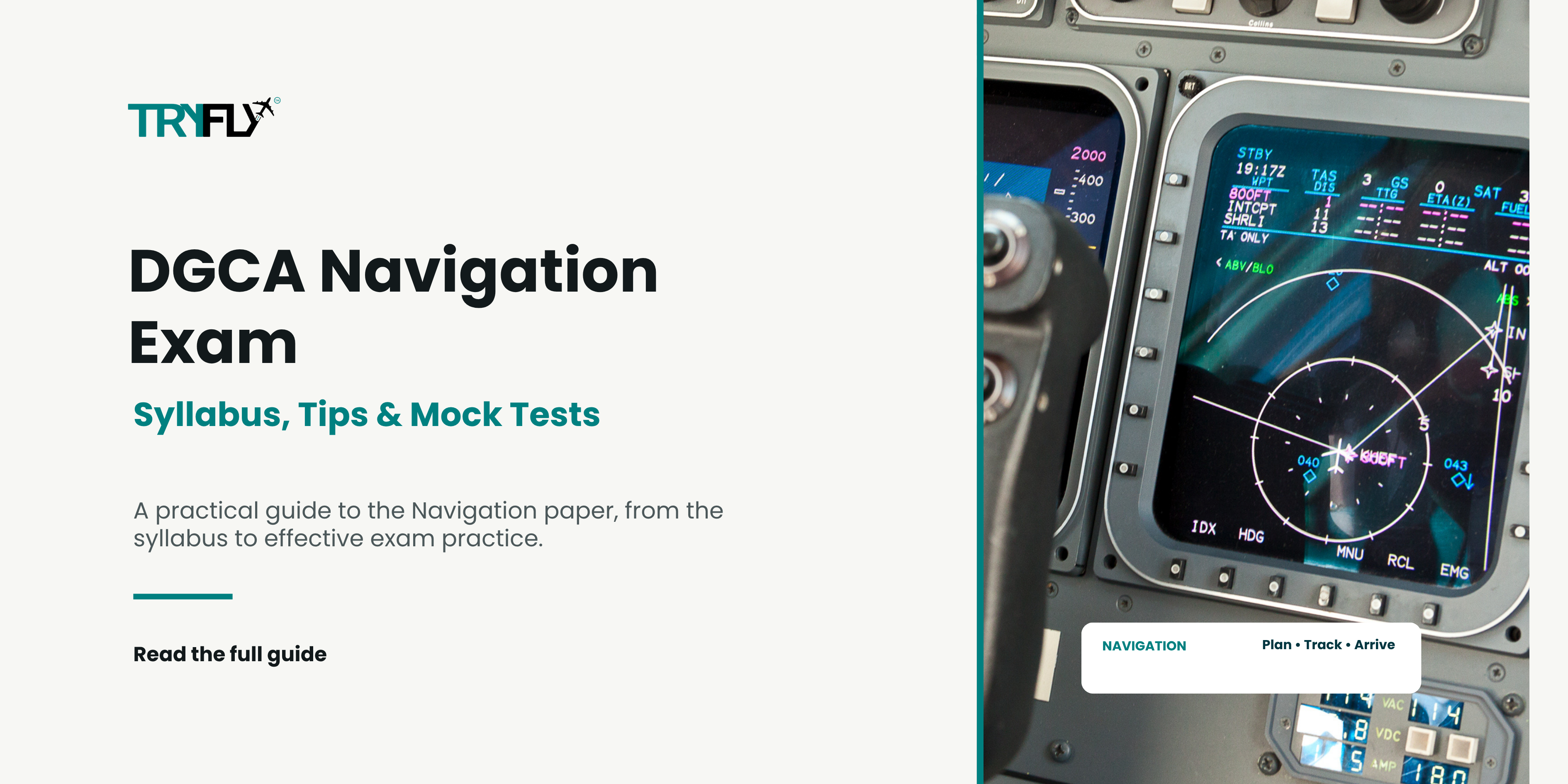
Air Navigation is widely considered the most challenging paper and one of the most important. With 100 questions over 3 hours, it tests your ability to think like a pilot solving real in-flight problems.
Key topic areas include:
- General Navigation and flight planning fundamentals
- Radio Aids: VOR, ILS, and GPS
- Flight instruments and their operation
- Mass and Balance calculations
- Aircraft Performance
- Latitude, Longitude, and map reading
- Fuel Policies and fuel calculations
The practical skills assessed here, including wind correction calculations, ETA computations, heading corrections, and wind drift, require you to be completely comfortable with the CRP-5 Flight Computer. Practise it until using it becomes second nature.
With 50 questions over 2 hours, this paper tests your understanding of the atmosphere and how it affects flight safety. Indian candidates have a genuine advantage here because the syllabus specifically includes the Indian Monsoon, a topic unique to our operating environment.
Core topics include:
- METAR and TAF weather reports: how to read and interpret them
- SIGMET advisories
- Pressure systems and frontal weather
- Jet streams and their impact on flight planning
- Thunderstorm development and avoidance
- In-flight icing hazards
- Cloud types and formation
This subject rewards visual learners. Drawing pressure charts, sketching frontal systems, and mapping weather patterns will help you retain concepts far better than passive reading ever will.
Arguably the most policy-dense paper, Air Regulations covers the legal framework within which all aviation in India operates. 50 questions, 2 hours.
Key areas include:
- Aircraft Rules 1937: India's foundational aviation legislation
- ICAO Annexes, especially those governing operations, airworthiness, and air traffic services
- Air Traffic Services (ATS) procedures
- Wake turbulence separation standards
- Licensing regulations and requirements
- Human Factors in aviation
- Aerodrome markings and signs
An important 2026 note: this paper now reflects the revised Flight Duty Time Limitations (FDTL) and updated pilot fatigue rules. Make sure your study material is current, because older textbooks will not cover these changes.
Technical General
Technical General is the longest paper on the list, with 100 questions over 3 hours, and it is a deep dive into how aircraft actually work. This is where your engineering curiosity pays off.
Topics covered include:
- Aerodynamics: lift, drag, stall characteristics, and the effects of flap configuration
- Aircraft systems: hydraulic, electrical, pressurisation, and anti-ice
- Aircraft engines: piston and jet propulsion principles
- Stability and Control: static and dynamic stability, control surfaces
Study strategy here is straightforward: understand the "why". Questions increasingly appear in scenario format, such as: what happens if the hydraulic system fails during approach? Conceptual clarity matters far more than memorising definitions.
Technical Specific
This paper is aircraft-specific. With 50 questions over 1.5 hours, it tests your knowledge of the Pilot Operating Handbook (POH) for the aircraft type you trained on. Common aircraft include the Cessna 172, Diamond DA42, and PA-28.
Key areas tested:
- V-Speeds: Vne, Vno, Vx, Vy, Vs, Vfe. Know them cold.
- Aircraft limitations and normal/abnormal checklists
- Fuel systems and fuel management
- Emergency procedures specific to your aircraft type
Don't underestimate this paper. Many students treat it as an afterthought, thinking it's "just the POH." The questions can be very precise. Read your POH cover to cover, more than once.
Key Changes in the 2026 Syllabus
The DGCA has been steadily evolving its examination philosophy, and 2026 continues that direction. Here is what you need to know.
Scenario-based questions are now the norm. Rather than asking you to define a term, examiners present a real flight situation and ask what action a pilot should take. This shift rewards candidates who have absorbed the reasoning behind every rule, not just the rule itself.
RTR(A) is now fully under DGCA. The Radio Telephony Restricted (Aeronautical) licence has been completely transferred from the earlier WPC system. Registration, slot booking, and assessment are entirely managed through the eGCA/PARIKSHA portal, and a DGCA Computer Number is now mandatory for RTR(A) registration. The format follows a clear two-part structure:
- Part A: Written MCQ test on radio telephony rules and communication procedures
- Part B: Practical simulated R/T environment covering readbacks, position reports, and operational RT handling
Passing RTR(A) remains a strict requirement for CPL in India. Do not leave it to the last minute.
PBN, FMS, and RNAV have increased weightage. Performance-Based Navigation, Flight Management Systems, and Area Navigation are appearing more frequently in the Air Navigation paper. If these topics feel unfamiliar, prioritise them.
FDTL rules are now examinable in Air Regulations. The revised Flight Duty Time Limitations reflect current DGCA policy. Study the latest DGCA CAR releases alongside your main textbook.
Step-by-Step Study Roadmap
Clearing all DGCA theory papers requires a structured plan, not just hours of reading. Here is how to approach your preparation efficiently.
Step 1: Get your DGCA Computer Number first: Register on the PARIKSHA portal and obtain your 10-digit Computer Number before anything else. It is free, issued for life, and mandatory before you can book any exam.
Step 2: Prioritise by difficulty and weightage: Start with Air Navigation and Technical General, as they carry the most questions and require the most practice time. Air Regulations and Meteorology can be studied in parallel once you have built momentum.
Step 3: Use reliable reference materials:
- Air Navigation: CAP697, Jeppesen charts, and CRP-5 practice workbooks
- Aviation Meteorology: DGCA-recommended AIC circulars; Pieter Hendrick Kollé's meteorology guide
- Air Regulations: DGCA CAR Sections 2 and 7; Shyamkant Tyagi's Air Regulations
- Technical General: Trevor Thom's Aircraft Technical Book series
- Technical Specific: The actual POH of your training aircraft. Nothing substitutes for the real document.
Step 4: Practice with purpose, not just volume: Reading textbooks cover to cover is a starting point, not a strategy. The real preparation happens when you test yourself repeatedly, identify exactly where your understanding breaks down, and go back to fix those gaps. Platforms like TryFly are built specifically for this kind of targeted DGCA preparation, combining mock tests, subject-wise practice questions, and performance tracking so you always know which topics need more attention and which ones you have genuinely mastered. That data-driven feedback loop is far more efficient than guessing what to revise next.
Step 5: Simulate before you sit: At least two weeks before your exam date, take full-length timed mock tests under exam conditions. This builds both speed and composure. Pay special attention to questions you answered correctly but were not fully confident about, because those are exactly the gaps that will cost you marks on exam day.
Step 6: Plan your exam sessions smartly: Regular sessions are held quarterly in March, June, September, and December. On-demand OLODE sessions are available per subject. For most candidates, the regular session route is the smarter financial choice.
Your Clearance Is Waiting — Start Early, Stay Consistent
The path to your wings runs through these papers. The DGCA exam syllabus in 2026 is more nuanced than ever, but it is absolutely clearable with a disciplined approach, the right resources, and genuine curiosity about aviation.
Every senior pilot you admire sat in exactly the same position you are in right now. They cleared the same subjects, wrestled with the same Navigation calculations, and memorised the same Air Regulations. The difference between those who cleared on the first attempt and those who struggled was rarely intelligence. It was the quality of preparation.
Start early. Study smart. And if you want a structured, exam-focused way to build that preparation, TryFly is a good place to begin.
The sky is waiting.
Frequently Asked Questions
- What is the minimum passing score in the DGCA theory exams? You need at least 70% in each individual paper to pass. There is no aggregate scoring. Every subject must be cleared independently on its own merits.
- How long are passed DGCA theory papers valid? Each cleared paper remains valid for 5 years from the date of passing. If you do not complete your licence requirements within this window, any expired papers will need to be reappeared.
- Is there a waiting period if I fail a paper? Yes. You must wait 42 days before reattempting that specific subject. Each reattempt requires a fresh examination fee, which is non-refundable and non-transferable.
- How do I register for the DGCA exams? All registrations are done through the PARIKSHA portal. You will need to create an account and obtain your DGCA Computer Number first, a free lifetime 10-digit identification number. Payments are processed via the Bharatkosh Government payment gateway integrated into the portal.
Ready to ace your DGCA exam?
Practice with TryFly's question banks and Vimaan simulator.
Start Practicing Free