
24 July 2026
What is the DGCA Exam? A Complete Beginner's Guide
If you're planning to become a commercial pilot in India, you'll hear one phrase repeated everywhere in your training journey: the DGCA exam. For most aspiring pilots, it's also the single biggest source of confusion and anxiety in the entire process. What exactly is it? How many papers do you need to clear? What's the actual pass criteria? This guide breaks down everything a first-time candidate needs to know.
What Is the DGCA Exam?
The DGCA exam refers to the set of mandatory theoretical ground exams conducted by the Directorate General of Civil Aviation, India's governing body for civil aviation. These exams test the theoretical knowledge every commercial pilot needs before they're allowed to fly professionally, covering everything from aviation law to weather patterns to aircraft systems.
Clearing these papers is a non-negotiable step toward earning a Commercial Pilot License (CPL). You can complete all your flight training hours, but without passing your DGCA papers, you don't get your license. The exams are computer-based, multiple-choice, conducted in English, and run in sessions throughout the year through the DGCA's official Pariksha Portal.
The pass mark is 70%, and it's applied to each subject individually rather than as an overall average. That single detail catches a lot of students off guard: scoring extremely well in one subject cannot make up for a weak score in another. Every paper has to clear the 70% mark on its own.
The Core DGCA Exam Subjects
Depending on where you complete your flight training, you'll need to clear up to six theoretical papers to earn your CPL.
1. Air Regulations
This subject covers aviation law: India's Civil Aviation Requirements (CARs), the Aircraft Act and Aircraft Rules, ICAO standards, airspace classification, licensing requirements, and procedures around accident reporting and search and rescue. It's largely theory-based rather than calculation-heavy, which is why most students find it one of the more scoring subjects.
2. Aviation Meteorology
Weather has a direct impact on flight safety, and this subject teaches you how weather systems form and behave. Expect topics like atmospheric structure, temperature and pressure, cloud formation, thunderstorms, turbulence, icing conditions, and how to read METAR and TAF weather reports. Increasingly, questions test your ability to apply this knowledge to real scenarios rather than just recall definitions.
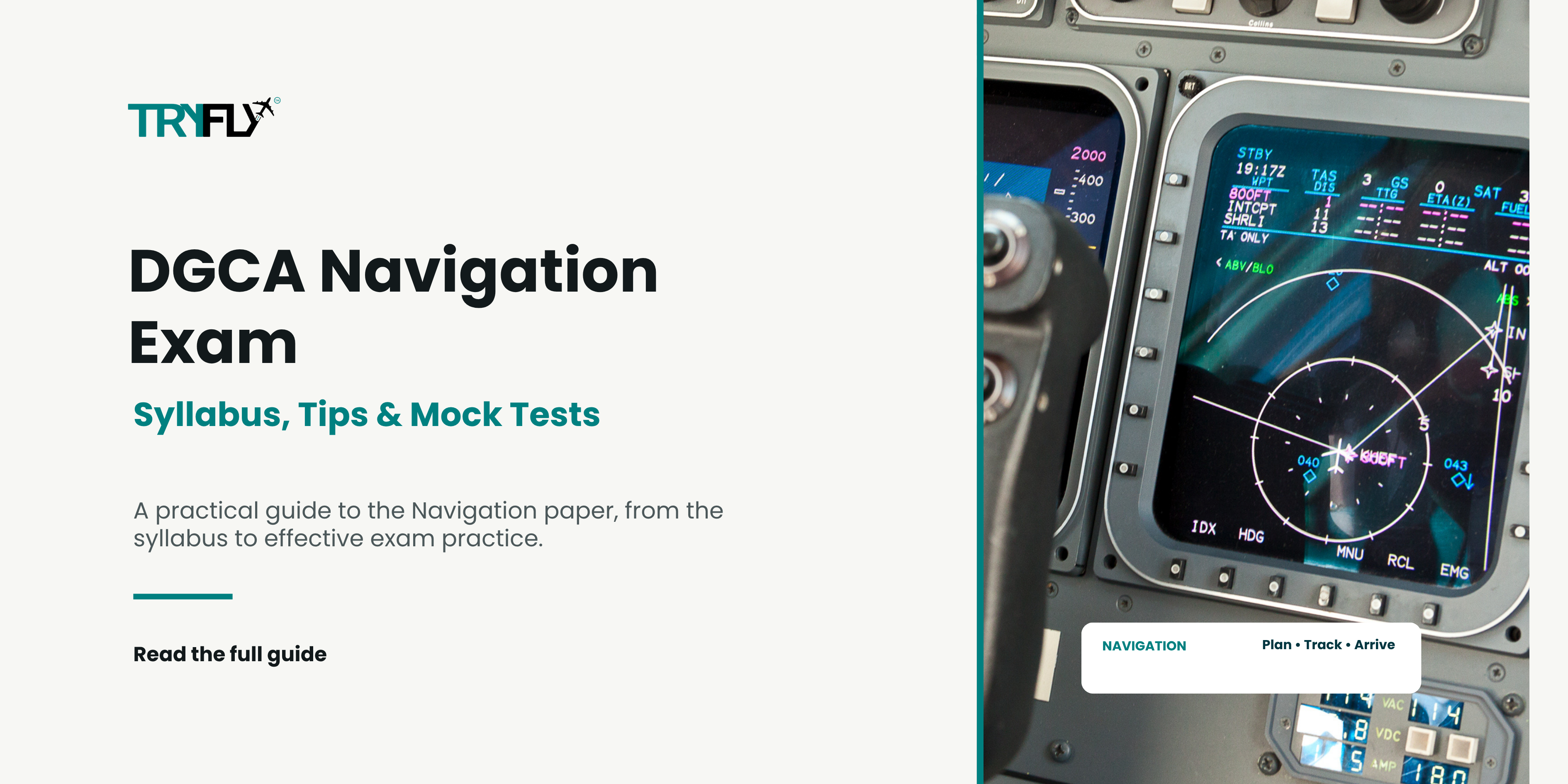
3. Air Navigation
Widely considered the most demanding subject, Air Navigation covers route planning, chart reading, radio navigation aids, and calculations using tools like the CRP- 5/ CX2 /CX3 flight computer. You'll work with latitude and longitude, dead reckoning, wind triangle calculations, fuel planning, and systems like VOR, DME, NDB, and ILS. Because it's calculation-heavy, it requires consistent numerical practice rather than last-minute revision.
4. Technical General
This subject builds your understanding of how aircrafts actually work: principles of flight, aerodynamics, aircraft structures, engines, electrical and hydraulic systems, flight instruments, and aircraft performance. It's detailed, so most students find it easier to absorb once they already have a grounding in Navigation and Meteorology.
5. Technical Specific
Unlike Technical General, this paper is based on the specific aircraft type you train on. It covers that aircraft's systems, performance data, operating limitations, emergency procedures, and weight and balance calculations. Since it draws directly from your flying school's aircraft and training manuals, it's usually attempted last, once you're already deep into flight training.
6. RTR(A) – Radio Telephony
RTR(A) is a bit different from the rest. It happens in two parts (Part 1 and Part 2) and is now conducted by the DCGA. It's mandatory for your license. This exam tests your knowledge of aviation phraseology, standard radio communication procedures, and emergency and distress communications with Air Traffic Control.
7. ELP (English Language Proficiency) exam
The English Language Proficiency (ELP) examination is a mandatory assessment that pilots must complete before obtaining a DGCA Commercial Pilot Licence (CPL). Based on ICAO standards, the test evaluates a pilot's pronunciation, vocabulary, fluency, comprehension, and ability to communicate effectively during both routine and non-routine aviation situations. Candidates must achieve at least ICAO Level 4 (Operational) to meet the minimum licensing requirement, ensuring they can communicate clearly and safely with air traffic controllers and other aviation personnel.
Eligibility & Prerequisites
Before you can register for any DGCA exam, you'll need to meet a few baseline requirements:
- Age: At least 17 years old for a Student Pilot License (SPL), and 18 for a CPL.
- Education: You need to have passed 10+2 with Physics and Mathematics. If you come from a Commerce or Arts background, you can still qualify by clearing these subjects separately through the National Institute of Open Schooling (NIOS) or a state open board.
- Medical Fitness: A valid Class II medical certificate is required for a PPL, and a Class I medical certificate for a CPL.
How to Apply for DGCA Exams
- Obtain a DGCA Computer Number through the DGCA Pariksha portal.
- Log in to the portal using your Computer Number.
- Select the examination session and subjects.
- Complete the online application and pay the examination fee.
- Download the admit card before the examination.
- Appear for the examination at the allotted exam centre.
Which Exam Should You Attempt First?
With six subjects and no fixed order, deciding where to start can be overwhelming. A commonly recommended sequence for beginners looks like this:
- Air Regulations – theory-heavy and scoring, a good confidence-builder to start with.
- Meteorology – logical and largely predictable with practice, and it lays groundwork that helps with Navigation later.
- Air Navigation – the most calculation-intensive subject, generally easier to tackle once Meteorology is out of the way.
- Technical General – detailed content that's easier to absorb once you're comfortable with Navigation and core aviation concepts.
- Technical Specific – aircraft-specific, so it's best attempted closer to or during flight training.
Following a logical sequence rather than jumping into the hardest subject first tends to build both confidence and exam readiness more effectively.
Why This Exam Trips Up So Many Students
A few structural realities of the DGCA exam catch first-time candidates off guard, and it's worth knowing about them well before exam day:
- No aggregate scoring. As mentioned earlier, each subject has to independently clear 70%. A strong score elsewhere doesn't offset a weak one.
- Topic weightage isn't fixed. DGCA doesn't guarantee the same distribution of questions every session, so a paper heavy on one topic this cycle could shift entirely in the next.
- Scenario-based questions over memorization. Increasingly, DGCA papers test practical application, like interpreting a real METAR report or working through a realistic navigation scenario, rather than asking for textbook definitions.
- 42- Day cooling period. If you fail a paper, you're required to wait a minimum of 42 days before you can attempt it again, which can delay your entire flight training and licensing timeline.
How to Prepare Effectively
- Build a structured study plan that gives calculation-heavy subjects like Navigation more time than purely theoretical ones.
- Practice with full-length, timed mock tests regularly rather than only reading notes. Mock tests are one of the most reliable ways to build pacing, spot weak subjects early, and get comfortable with the exam's actual question style before it counts.
- Focus on understanding concepts, not memorizing answers, since scenario-based questions are becoming more common across subjects.
- Revise consistently using formula sheets, navigation shortcuts, and topic summaries rather than cramming close to the exam date.
Final Thoughts
The DGCA exam is a demanding but very clearable milestone once you understand exactly what it involves: six subjects, a strict per-subject passing mark, and a format that increasingly rewards applied understanding over rote memorization. Going in with a clear study sequence and realistic mock test practice makes a measurable difference in first-attempt success.
If you're currently preparing and want to check exactly where you stand before your next attempt, TryFly offers a free demo mock test built on the real DGCA exam format, so you can identify your weak subjects with time to actually fix them.
Frequently Asked Questions
- There's no fixed limit on the number of attempts. You can retake a failed subject as many times as needed, though each failed attempt requires a mandatory 30-day cooling period before your next try.
- Yes. Once you clear your first subject, you're expected to complete all remaining papers within 5 years. If you don't finish within that window, your already-passed papers can expire and need to be reattempted.
- Yes. Many students clear their DGCA ground exams independently of where they complete their flight training, and it's common to sit these exams in India even while training in the US, South Africa, or elsewhere. Some students prefer clearing exams before starting flight training abroad specifically to avoid juggling both at once.
- No, ground classes aren't a legal requirement, but most students join them anyway for structure and guidance, especially for calculation-heavy subjects like Air Navigation.
- This varies a lot by student, but since you have a 5-year window from your first pass to finish everything, most students aim to clear all subjects well within that window to avoid re-validating expired papers.
- No. DGCA exams don't penalize wrong answers, so it's always better to attempt every question rather than leave any blank.
- Yes, and many aspiring pilots do this deliberately, clearing ground exams first while theory is fresh, then focusing entirely on flight training afterward without juggling both simultaneously.
How many attempts are allowed for DGCA exams?+
Do DGCA exam papers expire once you pass them?+
Can I give DGCA exams while training abroad?+
Is joining DGCA ground classes compulsory?+
How long does it typically take to clear all DGCA papers?+
Is there negative marking in DGCA exams?+
Can I take DGCA exams before joining a flying school?+
Ready to ace your DGCA exam?
Practice with TryFly's question banks and Vimaan simulator.
Start Practicing Free